


Why Can’t I Stop Overthinking? Understand the Loop and How to Gently Step Out

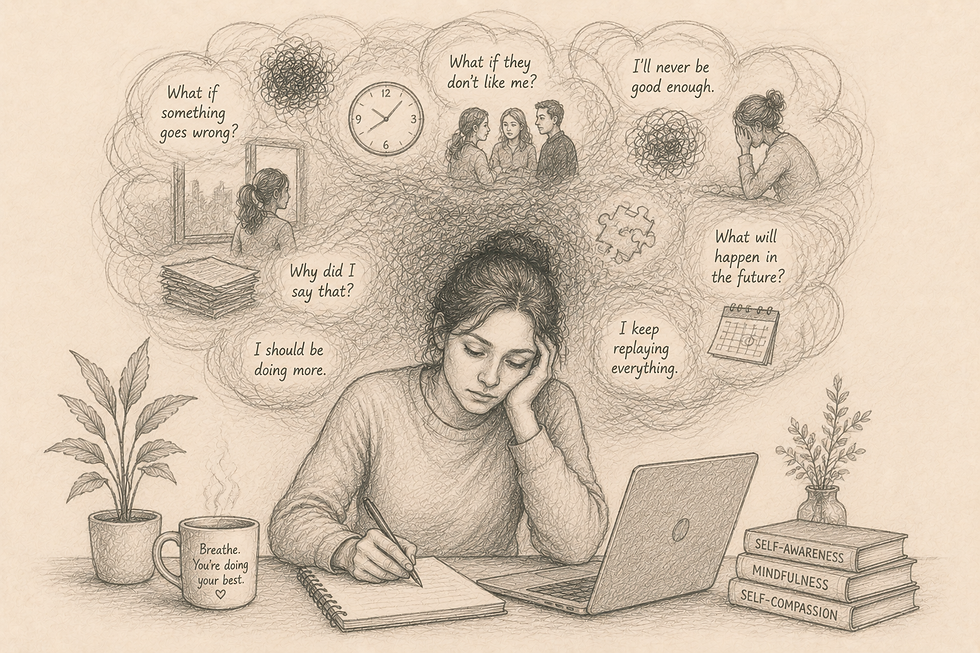
our brain’s safety system is loud. Our threat system evolved to prioritise caution. When it detects uncertainty, it pushes you to think more. Unfortunately, thinking can act like scratching an itch — it briefly soothes, then returns stronger.
Intolerance of uncertainty. If “not knowing” feels unbearable, the mind chases certainty by mentally rehearsing. But in life, certainty is limited. The chase becomes the trap.
Cognitive habits. Patterns like catastrophising (“It’ll be a disaster”), mind‑reading (“They think I’m incompetent”), or black‑and‑white thinking keep anxiety high and problem‑solving low.
Short‑term relief reinforces the loop. Reassurance‑seeking, endless researching, or checking can calm you briefly. Your brain then learns “overthinking works”, so it returns to it next time.
Old schemas get triggered. Deep patterns formed in childhood — such as fear of abandonment, failure, or a harsh inner critic — can fuel overthinking. This is where Schema Therapy can be powerful: we identify the “child” needs underneath the pattern and learn new ways to soothe and protect them. I explore this in my book, The Child Behind Your Patterns.
Body state influences thought state. Poor sleep, high caffeine, skipped meals and chronic stress sensitise your nervous system. A revved‑up body makes a revved‑up mind more likely.
Practical ways to ease overthinking today
You don’t need to “stop thinking”. The aim is to change your relationship with thoughts, reduce unhelpful loops, and move towards what matters. Try a few of these and keep what helps.
1) Label the process, not just the content
When a loop starts, gently name it: “I’m noticing worry,” or “I’m having the thought that…”. This comes from cognitive defusion work. Adding “I’m having the thought that…” creates a small, helpful distance between you and the thought, making it easier to choose your response.
2) Schedule “worry time” and park the rest
Pick a 15‑minute daily slot as your designated worry time. During the day, when worries pop up, jot them down and tell your mind: “Park it for 7pm.” At 7pm, review the list and ask:
Is this solvable? If yes, what’s my next small step?
If not solvable now, how can I care for myself whilst uncertainty exists?
This trains the brain that you are in charge of when to engage — not the other way around.
3) Ground your body to calm your mind
5‑4‑3‑2‑1: name five things you see, four you feel, three you hear, two you smell, one you taste.
Exhale‑led breathing: in for 4, out for 6–8, for two minutes to down‑shift the nervous system.
Temperature reset: splash cool water on your face or hold a cool glass to your cheeks for 30–60 seconds.
Grounding is not a cure; it creates enough steadiness to choose your next step.
4) From “what if” to “what now”
When a worry appears, ask: “What’s the smallest helpful action I can take in the next 10 minutes?” Send the email draft, set one calendar reminder, or sketch a plan on a sticky note. Action reduces the mind’s need to keep spinning.
5) Try a brief CBT behavioural experiment
Pick one feared prediction and test it kindly.
Prediction: “If I don’t triple‑check, I’ll make a huge mistake.”
Experiment: Proofread once, send, and note the outcome.
Review: Rate how often the feared outcome happened versus your prediction.
Over time, your brain learns from experience, not just fear.
6) Values‑based micro‑actions
Ask, “If anxiety wasn’t driving, what value would I choose right now — kindness, learning, connection, health?” Then take a 2‑minute step in that direction. Values give your mind a steadier compass than certainty.
7) Overthinking at night: create a wind‑down buffer
Set a “digital sunset” 60–90 minutes before bed; screens keep the mind switched on.
Journal a quick “brain dump” and list tomorrow’s first step; close the notebook physically.
Keep a notepad by the bed. If a thought returns, write it once and say, “I’ll meet you at worry time.”
Use a brief body scan or a calming audio to shift focus from thoughts to sensations.
Overthinking in relationships
It’s common to overthink texts, tone or timing with someone you care about. Three gentle shifts help:
Reality‑checking beats mind‑reading. Try, “When you went quiet, I noticed I worried I’d upset you. Is there anything we need to clear up?”
Set a reassurance rhythm. Agree how and when you’ll check in, so you’re not seeking constant reassurance or withdrawing.
Soften the inner critic. If you often assume “It’s my fault”, practise self‑compassion statements: “I’m doing my best, and relationships are messy sometimes.”
If spirals lead to frequent arguments, distance or mistrust, Couples Therapy can provide a safe space to understand patterns and build new ways of communicating.
When to seek extra support
Overthinking is interfering with sleep, work or your relationships.
You feel stuck in loops despite trying strategies, or your world is shrinking.
There’s significant anxiety, panic, or compulsive checking/reassurance.
Painful past experiences keep getting triggered.
Therapy offers a structured, compassionate space to understand what fuels your pattern, practise new tools and meet the needs underneath it. If you’re experiencing thoughts about harming yourself, please seek urgent support from your GP, NHS 111, or emergency services.
How therapy helps: CBT, Schema Therapy and an integrative approach
CBT (Cognitive Behavioural Therapy) helps you map your specific worry loops, challenge unhelpful thinking styles and run behavioural experiments that build confidence in real situations. We practise skills like worry postponement, probability balancing and compassionate self‑talk.
Schema Therapy looks deeper at recurring life patterns — the “always” and “never” beliefs that often began in childhood. If your overthinking is tied to a harsh inner critic, fear of getting it wrong, or people‑pleasing, Schema Therapy helps you recognise the younger parts of you seeking safety and respond with healthier adult strategies. I write about this in my book, The Child Behind Your Patterns.
As an integrative therapist, I blend these approaches with grounding techniques and practical planning. In Anxiety Therapy and Individual Therapy, we’ll tailor the work to your goals and pace — always collaborative, never rushed. Many people notice more space between a thought and a reaction, better sleep and kinder self‑talk as therapy progresses. There’s no promise of instant change, but there is a clear, compassionate path forward.
Working together
I’m Noush Navazani, a London‑based integrative therapist, author and doctoral researcher. Clients often tell me they feel deeply understood and steadily more confident to live beyond worry. If you’re ready to explore what’s underneath your overthinking — and build tools that fit your life — I’m here to help.
10. FAQ Section
Is overthinking the same as anxiety?
They overlap, but they’re not the same. Overthinking is a pattern of repetitive, unproductive thoughts. Anxiety is the emotion and body state that often accompanies it. Easing one usually helps the other.
Will CBT make me stop overthinking completely?
CBT doesn’t aim to eliminate thoughts, but to change how you respond to them. Most people learn to reduce loops, act more confidently and feel less controlled by worry.
How long does therapy take to help with overthinking?
It varies. Some feel benefits within 6–10 sessions of CBT‑informed work, whilst deeper patterns explored with Schema Therapy can take longer. We’ll agree a plan that fits your goals.
What if my overthinking is about my relationship?
That’s very common. We can work on patterns individually, and where helpful, Couples Therapy can support you both to communicate needs and reduce reassurance loops.
Is overthinking a sign of OCD?
Not necessarily. Many people overthink without having OCD. If you experience intrusive thoughts with compulsions (mental or behavioural) that take significant time, a tailored assessment can help.
Can lifestyle changes really help?
Yes. Sleep, caffeine, movement and nutrition influence your nervous system. Small shifts create a more settled base for the thinking skills to work.
11. Internal Link Suggestions
Anchor: “Anxiety Therapy” → Page: Anxiety Therapy
Anchor: “Individual Therapy” → Page: Individual Therapy
Anchor: “CBT (Cognitive Behavioural Therapy)” → Page: CBT (Cognitive Behavioural Therapy)
Anchor: “Schema Therapy” → Page: Schema Therapy
Anchor: “Couples Therapy” → Page: Couples Therapy
Anchor: “The Child Behind Your Patterns” → Page: The Child Behind Your Patterns (book)
12. Call to Action
If this resonated and you’d like calm, practical support to step out of overthinking, I’d love to meet you. Book a free 30‑minute consultation with me, Noush Navazani, and let’s explore what you need — no pressure, just a warm space to talk and a clear next step.


Comments