


How Childhood Family Roles Can Follow Us Into the Workplace

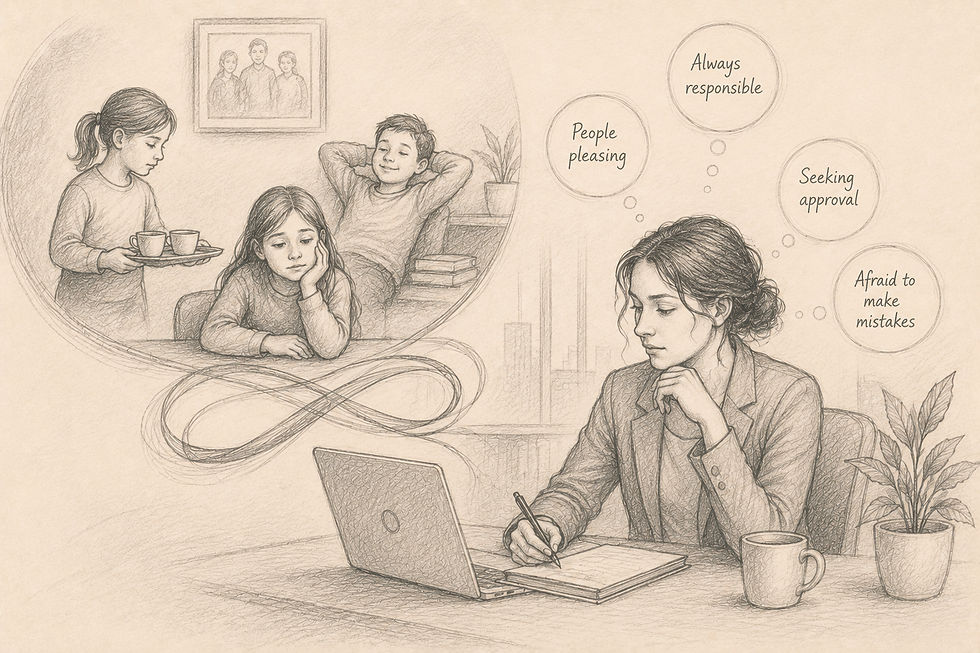
The strengths that once helped us feel safe, useful, or valued at home can quietly become patterns of overworking, perfectionism, and self-silencing in adult life.
“Don’t worry, I’ll handle it.”
For some people, this is not simply something they say at work. It is a role they have been rehearsing for years.
Long before our first job, many of us learn what helps us feel safe, accepted, or valued within our families. One child becomes responsible. Another keeps the peace. One achieves. One cares for everyone else. Another learns to stay quiet and need very little.
These roles are not diagnoses, and they do not necessarily mean that a family was unhealthy. They are often understandable adaptations. A child may become responsible because being dependable earns praise. Another may learn to avoid disagreement because keeping the peace protects connection. A high achiever may discover that success brings attention, security, or approval.
These qualities can become genuine strengths. Responsibility, sensitivity, ambition, and care can serve us well. The difficulty begins when they no longer feel like choices. When we carry an old family role into adult working life without noticing, a childhood strength can quietly become a professional obligation.
When a strength stops feeling like a choice
The responsible child may become the employee who accepts every extra task because letting someone down feels unbearable.
The achiever may build an impressive career while privately believing that rest must be earned and that an ordinary performance means personal failure.
The peacekeeper may become excellent at reading a room but avoid necessary disagreement, soften important feedback, or carry tension that belongs to the whole team.
The caretaker may become the unofficial emotional support person at work: remembering birthdays, checking on distressed colleagues, repairing misunderstandings, and absorbing responsibilities that are rarely recognised in a job description.
The quiet child may become highly capable but remain hesitant to share an idea, negotiate pay, take credit, or apply for a more senior position.
None of these patterns means that someone lacks confidence or ambition. In fact, workplaces often reward these qualities at first. The person appears dependable, adaptable, considerate, and easy to manage. The cost usually appears later.
Over time, reliability can become over-functioning. High standards can become perfectionism. Cooperation can become self-silencing. Care can become emotional exhaustion.
The important question is not whether a quality is good or bad. It is whether we can choose when and how to use it.
Responsibility is a strength when it is flexible. It becomes a burden when saying no threatens our sense of worth or belonging.
Why work can reinforce an old role
Workplaces provide powerful external rewards. The person who always says yes receives praise. The colleague who fixes every crisis becomes indispensable. The perfectionist produces excellent work, while the anxiety, long hours, and self-criticism behind it remain invisible.
An old pattern can gradually start to feel like a professional identity:
“I am simply hardworking.”
“I am the reliable one.”
“I work better under pressure.”
But hard work and workaholism are not the same. Research distinguishes healthy engagement from a compulsive drive to work. A major meta-analysis published in the Journal of Management connected workaholism with perfectionistic tendencies, job stress, burnout, and poorer wellbeing. Research has also documented increasing levels of perfectionism, particularly the feeling that other people expect us to be flawless.
This does not mean that every overworked adult developed the pattern in childhood. Human behaviour is shaped by many influences, including personality, culture, financial pressure, workplace expectations, and present circumstances. Early family roles are one possible part of the story, not the whole explanation.
Culture matters too
Conversations about boundaries sometimes imply that independence is always healthier than interdependence. But this does not reflect every person, family, or culture.
In many communities, supporting relatives, respecting authority, working hard, and being dependable are deeply meaningful collective values. Migration experiences and parental sacrifice can also make achievement and family responsibility feel especially important.
The aim is not to replace loyalty with individualism or treat family connection as a problem. It is to distinguish freely chosen commitment from fear-driven compliance.
You can care deeply about your team and still have limits. You can respect a manager and still raise a concern. You can remain connected to your family and culture without abandoning your own needs. You can be ambitious without making achievement the price of self-respect.
How to update the role without losing the strength
Pause before becoming the solution
When a new task appears, notice the speed of your response. Do you assess your capacity, or do you say yes before you have considered the cost?
Try saying: “Let me check my priorities and come back to you.”
A pause does not make you unhelpful. It creates room for an intentional decision.
Separate helping from rescuing
Helping supports another person’s ability to act. Rescuing repeatedly takes responsibility away from them and places it on you.
Before stepping in, ask: “Is this genuinely mine to carry?”
Practise small, professional boundaries
Boundaries do not need to sound cold or defensive. You might say:
“I can complete this by Thursday, or I can prioritise it today if we move the other deadline.”
This replaces an automatic yes with a realistic conversation about time, priorities, and resources.
Allow your work to be visible before it feels perfect
Perfectionism often promises protection from criticism. However, it can also delay decisions, creativity, and learning.
Before beginning a task, decide what “good enough for this purpose” means. Not every piece of work needs the same level of time, detail, or emotional investment.
Notice what guilt is saying
If declining a request produces guilt, ask whether you have acted against your values or merely against an old expectation.
Guilt can sometimes signal that we have caused genuine harm and need to repair something. But it can also appear when we challenge a familiar role. Discomfort is not always proof that a decision is wrong. Sometimes it is evidence that a pattern is changing.
Expand your definition of professionalism
Professionalism is not endless availability. It includes communicating capacity, asking for clarity, giving honest feedback, sharing responsibility, and producing work sustainably.
What leaders and organisations should notice
This is not only an individual responsibility. Organisations can become dependent on employees who over-function.
Good leaders should notice who consistently performs invisible emotional labour, who is repeatedly expected to rescue urgent work, and whose reliability has become an excuse for an unequal workload.
They should also make it safer for employees to disagree, clarify priorities, ask questions, and acknowledge their capacity limits. Research on psychological safety consistently shows that people are more willing to raise ideas and concerns when the interpersonal risk of speaking is lower.
A sustainable team is not one in which the same person repeatedly saves the day. It is one in which responsibility, knowledge, and voice are shared.
A final reflection
The aim is not to become less caring, ambitious, thoughtful, or dependable. Those qualities may be genuinely yours.
The work is to separate them from the old belief that you must perform a particular role to remain valued.
Perhaps the most useful career question is not only, “What am I good at?” It is also:
Which of my strengths still feel like choices, and which ones have become rules?
Explore these patterns further
These themes are explored in greater depth in my book, The Child Behind Your Path. The book looks at how early emotional experiences can influence recurring adult patterns, including people-pleasing, perfectionism, overthinking, boundaries, self-worth, and relationships. It also offers reflective exercises informed by psychological approaches including CBT, schema therapy, and mindfulness.
Add a direct link to The Child Behind Your Path here.
If you recognise yourself in these patterns and would like support exploring them, you can learn more about my therapeutic approach or book an initial consultation through this website.
Research and further reading
Clark, M. A., Michel, J. S., Zhdanova, L., Pui, S. Y., and Baltes, B. B. (2016). All work and no play? A meta-analytic examination of the correlates and outcomes of workaholism. Journal of Management, 42(7), 1836–1873.
Curran, T., and Hill, A. P. (2019). Perfectionism is increasing over time: A meta-analysis of birth cohort differences from 1989 to 2016. Psychological Bulletin, 145(4), 410–429.
Edmondson, A. C., and Bransby, D. P. (2023). Psychological safety comes of age: Observed themes in an established literature. Annual Review of Organizational Psychology and Organizational Behavior, 10, 55–78.
Kağıtçıbaşı, Ç. (2005). Autonomy and relatedness in cultural context: Implications for self and family. Journal of Cross-Cultural Psychology, 36(4), 403–422.


Comments